
Guide · Comparing the costs
Generator or solar: what does a night of power cuts really cost in Lomé?
Published 1 November 2026 · 7-minute read
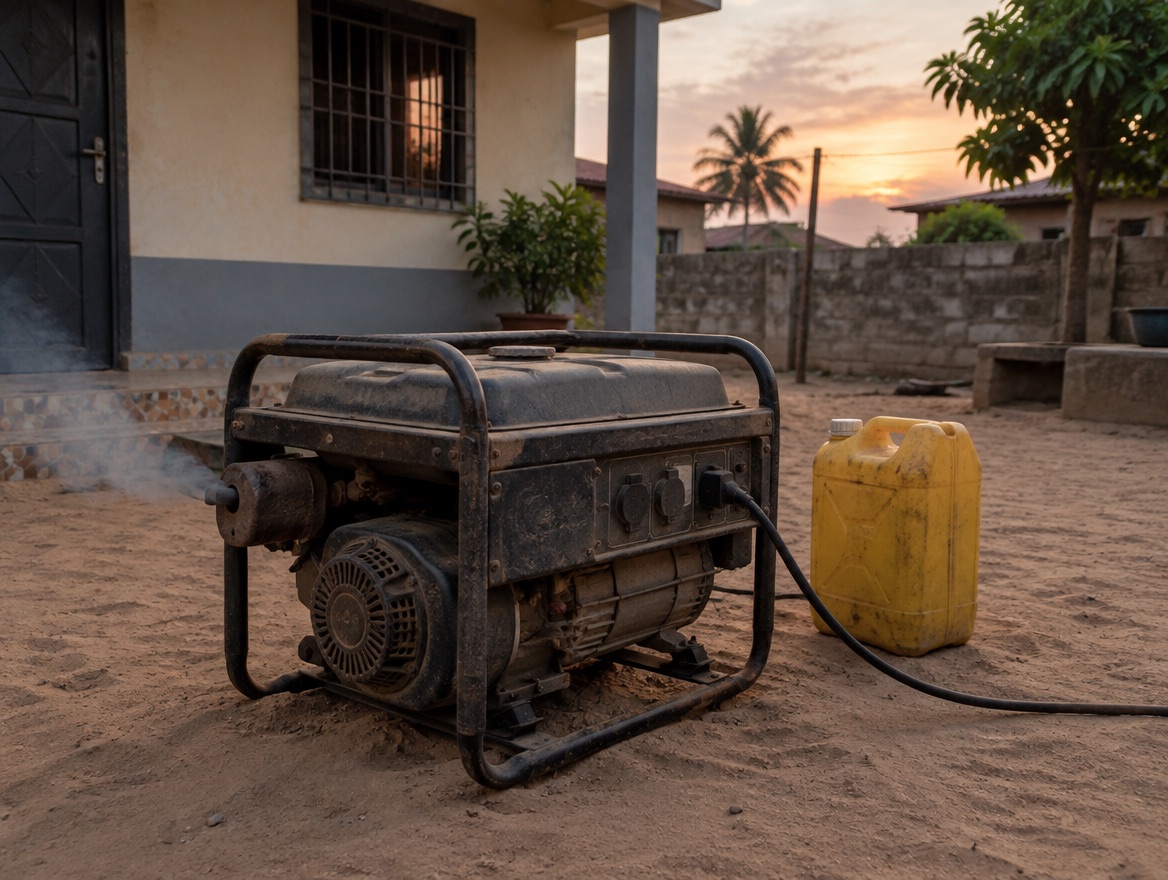
The calculation fits in one line
The fuel for a power cut comes from three numbers: the generator's consumption (litres per hour) × the length of the cut (hours) × the price of a litre (FCFA). The sections below give each number with its source, then the result for four situations. You can swap in your own assumptions: the formula stays the same.
These figures come from a price order reported by the Togolese press and from manufacturers' datasheets, not from measurements taken at customers' homes. Read them as orders of magnitude. All sources, with dates, are at the bottom of the page.
The price of a litre: 817 FCFA since 11 September 2026
In Togo the pump price of petrol is set by joint ministerial order. The latest price we found dates from 11 September 2026: a litre of super unleaded rose from 725 to 817 FCFA, up 92 FCFA, under an order dated 10 September. It had already gone from 680 to 725 FCFA on 27 May 2026, in a 2026 budget that cuts the fuel subsidy allocation by 40%.
In a little under four months the litre has therefore gained 137 FCFA, about 20%. An administered price can be revised at any time: that is the risk specific to a generator, whose bill follows the pump. At one litre an hour, every 50 FCFA on the litre adds about 400 FCFA to an 8-hour night.
We found no order later than 11 September as of 1 November 2026. If the price shown at your station is different, put that price in place of 817 in the formula.
What a small petrol generator burns
Datasheets for small generators give consumption at 50% load, sometimes at full load. Three generators with a public datasheet:
| Generator (datasheet) | Load | Consumption | Cost of an hour at 817 FCFA/L |
|---|---|---|---|
| Honda EU22i, inverter, 1.8 kW rated, 3.6 L tank | eco mode | ≈ 0.34 L/h (3.6 L for 10.5 h) | ≈ 280 FCFA |
| Honda EU22i | full load, 1.8 kW | ≈ 1.07 L/h (3.6 L for 3.35 h) | ≈ 880 FCFA |
| Contimac GR 3500 AVR, 3 kW continuous, 18 L tank | 50% (1.5 kW) | 1.01 L/h | ≈ 825 FCFA |
| Contimac GR 3500 AVR | 100% (3 kW) | 2.01 L/h | ≈ 1,640 FCFA |
| Konner & Sohnen KS 3000E, 2.6 kW rated, 15 L tank | 50% | ≈ 1.0 L/h (15 L for 15 h) | ≈ 820 FCFA |
Two lessons. First, at half load, both 2.6 to 3 kW generators run at around one litre an hour. Second, consumption does not fall as fast as the load: a 3 kW generator powering only a few lamps and a television burns proportionally far more than at half load. The datasheets do not give that point and we do not make it up: for the evening without air conditioning we therefore use the small inverter generator in eco mode, which is the case most favourable to the generator.
Four situations, with numbers
| Situation | Generator used | Petrol | Cost at 817 FCFA/L |
|---|---|---|---|
| 4-hour evening with no air conditioner: a few LED lamps, television, internet router, fan (around 150 W) | small inverter, eco mode, 0.34 L/h | ≈ 1.4 L | ≈ 1,100 FCFA (floor) |
| 4-hour evening with one 12,000 BTU air conditioner and the essentials (around 1.5 kW) | 3 kW at half load, 1.01 L/h | ≈ 4.0 L | ≈ 3,300 FCFA |
| 8-hour night with one 12,000 BTU air conditioner and the essentials | 3 kW at half load, 1.01 L/h | ≈ 8.1 L | ≈ 6,600 FCFA |
| 8-hour night with two air conditioners and the essentials | 3 kW close to full load, 2.01 L/h | ≈ 16.1 L | ≈ 13,100 FCFA |
A 12,000 BTU inverter air conditioner, the most common size, draws about 1,150 W when running, according to our guide running an air conditioner all night on solar: add lighting, the television, the router and a fan and you reach around 1.5 kW, half of a 3 kW generator. The appliance wattages are our assumptions; the generator's consumption comes from the datasheets.
Every line is a minimum: it counts neither the purchase of the generator, nor oil, spark plug and filter, nor repairs, nor the time spent buying and watching the petrol. The "floor" line assumes a recent small inverter generator; an old 3 kW unit running just a few lamps burns more.
The generator's kilowatt-hour: about 550 FCFA
Expressed per unit of energy produced, the datasheet consumption at 50% load and above is 0.6 to 0.77 litre per kilowatt-hour: 0.67 for the Contimac, 0.60 for the Honda at full load, 0.77 for the Konner & Sohnen taking 50% of its 2.6 kW. At 0.67 litre per kWh and 817 FCFA a litre, one kilowatt-hour from a generator costs about 550 FCFA in fuel, between 490 and 630 FCFA depending on the unit.
The CEET residential tariff we use in our guide how much does a solar kit cost is around 150 FCFA a kWh. A generator's kWh therefore costs about 3.6 times as much, for the fuel alone.
Against a NOMADE station and a solar kit
| Petrol generator | NOMADE station | Residential solar kit | |
|---|---|---|---|
| Fuel per power cut | from ≈ 1,100 to ≈ 13,100 FCFA per evening or night (table above) | none; recharged by the supplied panel, or from the grid for a few tens of FCFA | none |
| Purchase price | generally far below the price of a solar kit | not announced: range in preparation | 1,910,000 to 9,000,000 FCFA, founding price, installation included |
| Starting | by hand: it does not start by itself | automatic switchover when the power cuts | automatic takeover, no perceptible interruption |
| Noise, smoke | yes: 68 to 74 dB(A) on the datasheets, exhaust gases | silent, no smoke | silent, no smoke |
| Upkeep | engine: oil, spark plug, filter, petrol storage | no engine | no engine |
| Air conditioning | yes, if the power is enough | no | yes, that is its job |
| Installation | none, but it must stand outdoors | none, no drilling | fitted by certified partners |
For the NOMADE station, the characteristics are those of our specification, published on the NOMADE page: prices and launch date will be announced first to waiting-list members. Recharging from the grid is counted at the CEET tariff, around 150 FCFA a kWh, which is under a hundred FCFA to fill a NOMADE 500 (500 to 600 Wh). Kit prices are founding prices, ten places, installation included, reservations open until 31 January 2027: see the kits and the founding-customer offer.
How many nights of fuel pay for a kit?
The formula: nights = kit price ÷ fuel for one night. We compare each kit with the night it covers, according to our range: the Studio kit carries one 12,000 BTU air conditioner, the Apartment kit carries two.
| Kit (founding price, installation included) | 8-hour night on a generator | Nights to equal the price | At 50 nights a year | At 100 nights a year |
|---|---|---|---|---|
| Studio · 1 bedroom: 1,910,000 FCFA | one air conditioner and the essentials: ≈ 6,600 FCFA | ≈ 290 | ≈ 5.8 years | ≈ 2.9 years |
| Apartment · 2 bedrooms: 2,490,000 FCFA | two air conditioners and the essentials: ≈ 13,100 FCFA | ≈ 190 | ≈ 3.8 years | ≈ 1.9 years |
The number of nights of power cuts per year is a textbook assumption: we have no reliable statistic per household in Lomé, and yours is the only one that matters. The honest reading fits in two sentences. If the power fails only a few nights a year, a generator, cheaper to buy, is easily enough for your budget. The longer and more frequent the cuts, the more the fuel weighs, and the closer solar gets.
This calculation is tough on solar: it counts neither the purchase nor the servicing of the generator, nor the CEET bill that the kit lowers all year round, outside the power cuts. Our guide on kit prices puts that payback, against the CEET tariff alone, at three to five years.
Noise, smoke, upkeep, safety
Noise. The datasheets of the two 3 kW generators state 74 dB(A) (Contimac) and 68 dB(A) sound pressure (Konner & Sohnen), under the manufacturer's measurement conditions. It is a continuous noise for the whole power cut, night included, for you and for your neighbours.
Smoke and upkeep. A petrol engine gives off exhaust gases and needs its service schedule (oil, spark plug, air filter). A neglected generator fails at the worst moment, often during a long power cut. Refuel with the engine off and cooled down, as manuals generally require.
Safety. Never run a generator in an enclosed space: house, cellar, garage. It produces carbon monoxide, a gas you cannot see or smell. The guidance of health authorities is simple: place it outdoors, away from windows, doors and any opening, and keep a working carbon monoxide alarm in the house. A headache, dizziness or nausea while the generator is running is a warning sign: get into fresh air and switch the generator off. This rule costs nothing and applies to every generator, whatever its age.
How to choose
The rule on our site fits in one line: no air conditioner? NOMADE. An air conditioner? Residential kit.
- Without an air conditioner, an evening on a generator already costs at least 1,100 FCFA in fuel, with the noise and the smoke. A NOMADE station takes over with no fuel; its prices have not been announced yet.
- With one or more air conditioners, it is the residential kit that covers the whole night, and its size is chosen by counting air conditioners: see which kit for my home.
- To compare the four answers to power cuts, from pocket lamps to a complete kit: power cuts in Lomé: what to do. To see what makes up the price of a kit: how much does a solar kit cost in Togo.
None of these solutions promises unlimited autonomy: each lasts only as long as its fuel, or its battery and panels, allow, no more.
Frequently asked questions
- How much does a night of power cuts cost with a generator in Lomé?
- For petrol alone, about 6,600 FCFA for an 8-hour night with a 3 kW generator at half load (1.01 litres an hour, at 817 FCFA a litre), and about 3,300 FCFA for a 4-hour evening. A light load on a small inverter generator comes down to around 1,100 FCFA for 4 hours; two air conditioners on a 3 kW generator close to full load rise to about 13,100 FCFA a night. The purchase, servicing and repairs of the generator come on top.
- What is the price of a litre of petrol in Togo in 2026?
- 817 FCFA a litre for super unleaded since 11 September 2026, under the joint ministerial order of 10 September. It was 725 FCFA from 27 May 2026, and 680 FCFA before that. This is the latest published price we found as of 1 November 2026.
- How much petrol does a small generator burn per hour?
- According to the datasheets cited in this guide: about 1 litre an hour at half load for a 2.6 to 3 kW generator (1.01 L/h for the Contimac GR 3500 AVR, about 1.0 L/h for the Konner & Sohnen KS 3000E), and about 2 litres an hour at full load for a 3 kW unit (2.01 L/h). A small 1.8 kW inverter generator (Honda EU22i) drops to about 0.34 L/h in eco mode.
- Is solar cheaper than a generator in Lomé?
- Per power cut, yes: a solar kit or a NOMADE station uses no fuel. To buy, no: a generator generally costs far less than a kit, whose founding prices run from 1,910,000 to 9,000,000 FCFA, installation included. The fuel of a 3 kW generator at half load equals the price of the Studio kit after about 290 eight-hour nights: the more frequent the cuts, the closer solar gets. NOMADE prices have not been announced yet.
- Can you run a generator inside the house or the garage?
- No. A generator produces carbon monoxide, a gas you cannot see or smell. Health authorities say never to run one in an enclosed space (house, cellar, garage) and to place it outdoors, well away from windows and openings. A working carbon monoxide alarm in the house is recommended.
- Does a NOMADE station replace a generator?
- For lights, the television, the internet router, a fan, a laptop and, depending on the model, a refrigerator: yes, with no fuel, no noise and automatic switchover. For an air conditioner: no, you need a residential solar kit. The NOMADE range is in preparation and its prices have not been announced yet.
Sources and method
Sources consulted on 1 November 2026. The datasheets are those of manufacturers or their retailers; their measurement conditions are not always specified.
- Price per litre, 817 FCFA (11 September 2026): Koaci, “Togo : hausse des prix du carburant, le super sans plomb passe à 817 F CFA” (in French), 11 September 2026. The article text gives 817 FCFA; the price list beside it mistakenly repeats the old price of 725 FCFA. The joint ministerial order of 10 September 2026 is also reported by Yop L-Frii (in French), 11 September 2026.
- Earlier prices, 680 then 725 FCFA (27 May 2026), and the 40% subsidy cut: Togo First, 27 May 2026.
- Contimac GR 3500 AVR (3 kW continuous, 18 L tank, 1.01 L/h at 50% load, 2.01 L/h at 100%, 74 dB(A)): Contimac product sheet (in French).
- Konner & Sohnen KS 3000E (2.6 kW rated, 3 kW maximum, 15 L tank, 15 h at 50% load, 68 dB LpA): Bricozor sheet (in French). The 1.0 L/h figure is derived from 15 L over 15 h.
- Honda EU22i (inverter, 1.8 kW rated, 3.6 L tank, 3.35 h at continuous power, 10.5 h in eco mode): datasheet published on be.ch (canton of Bern, civil protection; in French). The 1.07 and 0.34 L/h figures are derived from those run times.
- Carbon monoxide: US Consumer Product Safety Commission, “Generators and Engine-Driven Tools” (never indoors or near a window, keep a working CO alarm); ARS Nouvelle-Aquitaine, “Éviter les risques d'intoxications au monoxyde de carbone” (in French; never place a generator in an enclosed space, install it outdoors).
- AFRO-ENERGY facts: founding prices, kit contents and the NOMADE specification from the homepage, the founders page and the NOMADE page; air-conditioner consumption from our guide; the CEET tariff of about 150 FCFA a kWh from our price guide.
Formulas: fuel (FCFA) = L/h × hours × price per litre; cost of a kWh = litres per kWh × price per litre; nights to equal a kit = kit price ÷ fuel for one night. Rounded to the nearest hundred FCFA.